

You have just learned that you need a blood stem cell or bone marrow donor from outside your family – none of your siblings are candidates to donate for you. How will you and your transplant team know when you have the right person? If a person is available and wants to donate, why can’t they give their cells to any patient in need?
Transplants are not that simple. And while many people suppose the choice of donor could be related to blood type, that isn’t even considered. The most important factor for this type of transplant is your immune system – specifically your Human Leukocyte Antigens, or HLA.
HLA are markers on the surface of nearly every cell in your body, and for a transplant to be possible, your HLA profile and that of a potential donor need to be compatible. If they aren’t, those differences could make a transplant difficult, or impossible.
Human Leukocyte Antigens are part of the human histocompatibility complex, which determines most of your immune system. Immune systems are ancient, going back about 450 million years to the first vertebrates with jaws.
In humans, Chromosome 6 contains the genes that define the histocompatibility complex, and these genetic codes tell the immune system how to work. Nearly every cell in your body displays special proteins on its surface – think of these as little trays that show off a form of ID card called “antigens.” As the cells travel, T cells check the trays, and if they see an ID showing healthy “self” antigens, the T cells leave it alone. If the cell is infected by a virus or has become cancerous, the ID on the tray will show abnormal antigens indicating “not self.” The T cell may tell that cell to self-destruct or call in other immune system cells to destroy it.
If a malfunctioning cell is still showing a "self" ID to the T cells, they may be unable to identify it as being dangerous and it could proliferate out of control and harm the body. The purpose of a stem cell or marrow transplant is to replace the entire bone marrow system that produces all blood cells, which also creates a new, fully functional immune system.
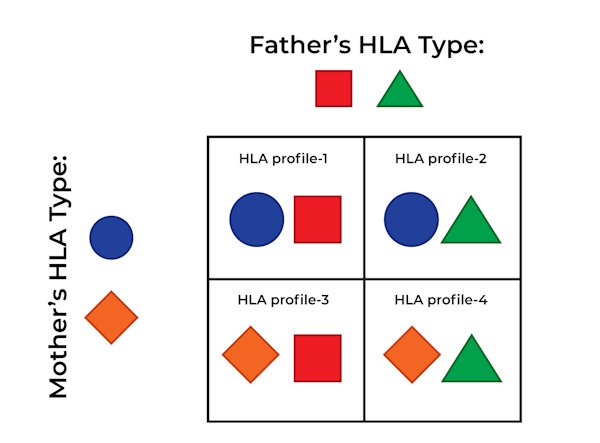
Your HLA profile comes from your parents and your ancestors. You inherit 50% of your HLA from your biological father and the other 50% from your biological mother. This means that each of your parents is a 50% match (or half-match) for you, which doctors call “haploidentical.”
Each one of your siblings has a 25% chance of being a perfect match for you, a 50% chance of being a half-match, and a 25% chance of not matching you at all. This is why families are the first ones tested to search for donors – a 25% chance of a matching sibling is a much higher opportunity than finding a match in the general population. But not every sibling matches, and sometimes siblings who match the patient are unable to donate for other reasons – their own health, for example.
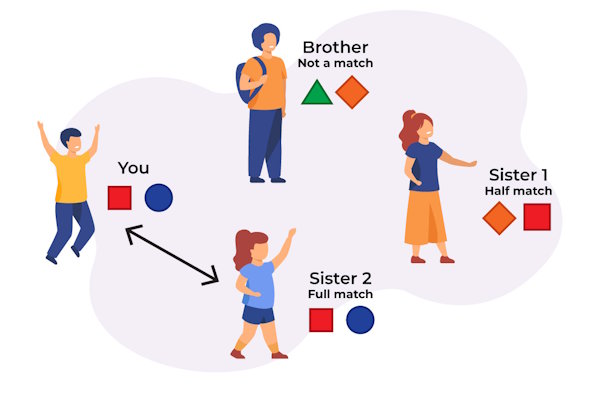
We know from over six decades of transplant statistics that approximately 30% of patients are able to find a compatible match with a family member. But this means 70% of patients do not have a viable match in their family, and their best option is to search for an unrelated donor. That search happens through donor registries like Gift of Life, which participate in an international donor database managed by the World Marrow Donor Association.
When a donor registry or a transplant center tests a person’s HLA, the results look at a specific portion of Chromosome 6 – the 6p21 region – that holds the genes for the HLA system.
The test examines what genes appear in the loci known as HLA-A, HLA-B, HLA-C and HLA-DRB1. Each of these loci contains two alleles, one from each parent, for a total of 8 alleles. A “perfect” match would mean all 8 alleles are the same in both the patient and the donor.
Extended typing looks at two additional loci by testing HLA-DQB1 and HLA-DPB1, raising the possible number of matching alleles to 10 or 12.
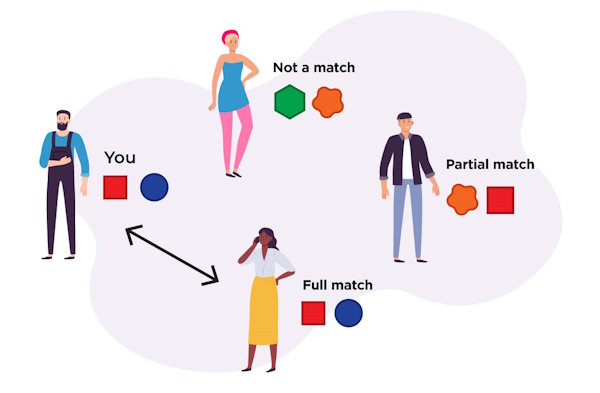
When there is a strong match between the donor’s and patient’s HLA type, this gives a higher chance of transplant success. A partial match between the types means there is a difference in one or more of the alleles.
Why does matching matter so much? Before the transplant takes place, the patient’s own bone marrow and immune system are eliminated, so the two immune systems won’t fight each other. After the infusion, the transplanted stem cells know exactly what to do: they migrate into the bone marrow areas and begin producing new blood cells and a new immune system – a process called “engraftment.”
Sometimes the grafted cells don’t see the recipient’s cells as being similar enough and generate an immune response to attack them. This is called “graft vs. host disease” and can range from mild cases to long-term challenges. The greater the difference in HLA, the higher the risk of this occurring. Occasionally, grafts can also fail for other reasons, including viral infections, or too low a number of viable stem cells. Some patients in this situation go on to receive a second transplant from a different donor.
Fortunately, recent treatment developments mean that partially matched donors can now be used successfully for some patients. “No perfect match” no longer means “no transplant.”
After engraftment, the new immune system will help eliminate any remaining cancer cells it finds, or replace the malfunctioning system that was causing the disease.
As we learned earlier, HLA alleles are inherited from our biological parents and their ancestors, stretching back for millennia. But HLA alleles are not the same in every population and are not evenly distributed around the world. For millions of years, humans have moved around to settle the entire planet, with populations remaining in specific geographic locations for thousands of generations.
In these local pockets of humanity, new HLA alleles appeared, and those that were effective were passed down through many generations. Some HLA alleles that may have been eliminated within a population by an epidemic continued to exist in distant locations. This resulted in genetic differences naturally developing over the ages, so one population would have a few rare HLA alleles, and another population ended up with a different set of rare variations. Over long spans of time, HLA became population-specific.
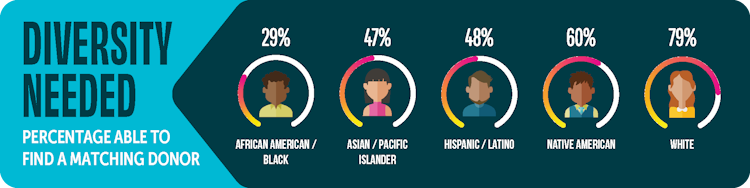
What this means for patients is that it is statistically more likely to find their HLA donor match among people who share their same genetic heritage – whose ancestors, going back many generations, came from the same geographic regions or population groups.
Finding matches for rare variations becomes especially important for patients of mixed ancestry, who may have inherited a rare HLA allele from both sides of their family. While each of these alleles may be common somewhere, when paired together they are extremely rare, making an exact match harder to find. Fortunately, the worldwide registry database of donors has grown substantially over the years and is now more diverse than ever.
As of this writing, there are more than 44 million donors (and cord blood products) in the global database. But that doesn’t mean 44 million equal chances to find a match because of the challenge of matching rare HLA profiles.
Matching depends on having compatible donor candidates. A genetically diverse registry offers more chances for patients, and donors with uncommon HLA types are urgently needed. It’s not only about adding more numbers to the registry, but it’s also about getting more genetic variation into the donor pool. Every population can help add the genetic diversity essential for saving someone’s life.
Scientists are still discovering HLA alleles that were not known previously. They didn't just appear, it's simply that no one carrying them had ever been tested before. Currently, there are 46,652 distinct HLA alleles, and new ones are discovered all the time. In July 2026, 648 new alleles were identified!
People sometimes wonder why intermarriage doesn’t eventually smooth out all the differences in HLA and reduce the number to just a few. But nature favors a large amount of variety, so it is constantly mixing together the alleles that already exist. Those that don’t work out well literally die out, while useful ones survive and are passed on. While new HLA mutations can also arise easily, it takes millennia for useful ones to spread through a line of descendants to become part of an entire population’s biology. It’s natural selection in a nutshell.
Finding the right donor, then, brings us back to the question we started with: who can give you the best chance for a successful transplant? The answer lies not in blood type or willingness alone, but in the compatibility of your HLA profiles—and, when a perfect match isn’t available, the new medical options your transplant team can consider. The same inherited diversity that makes each person’s HLA profile distinctive also makes the search more complex, which is why a genetically diverse donor registry matters so much. For someone waiting for a transplant, a person outside their family may turn out to be the match they need—and a willing donor’s unique genetic heritage may become another person’s chance at having a future.
If you are between 18 and 35, in general good health, and would like to join Gift of Life to learn if you’re a match for a patient in need, please click here to order your swab kit.