

Among notable Jewish leaders in the United States, two names stand out: Charles Bronfman, prominent philanthropist and co-founder of the Birthright Israel program, and Jay Feinberg, founder and CEO of Gift of Life Marrow Registry. The two have worked together to save lives since 2004, when Feinberg was named the first honoree of The Charles Bronfman Prize, a humanitarian award recognizing individuals who embody Jewish values and provide inspiration to emerging generations.
On December 16, invited local supporters to hear the two men speak, and to both celebrate the 20th anniversary of Feinberg’s award. It was also 30 years since he received a marrow transplant to cure leukemia, after a four-year search for a matching donor. More than 80 people attended the exclusive event at The Breakers.
When they first met, Bronfman and Feinberg realized their two organizations could become a source of volunteer stem cell donors by offering Birthright participants a chance to pay it forward by joining the registry. To date, more than 104,000 young Jewish men and women have volunteered as potential donors, resulting in over 600 transplants for patients in need to cure leukemia, lymphoma, and inherited immune disorders.
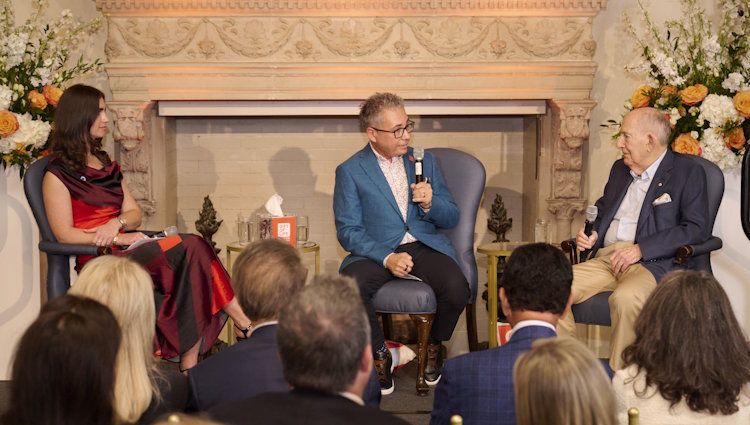
Gift of Life Board of Directors member Julia Kingsley moderated a discussion between the two men about their personal histories of being innovators, creating impactful organizations that have changed hundreds of thousands of lives, and their hope for their future legacies.
Kingsley asked them to discuss their experiences as innovators, and what key problems they had set out to solve.
“For me one of the biggest innovations was cheek swabs,” Feinberg responded. “Until the year 2000, we were not doing cheek swabs, it was a blood test [to join the registry]…which required us to contract phlebotomists to come to the drive, draw blood, then ensure it was packed and delivered to the lab within 24 hours. Many times, they did not show up, and we couldn’t have a donor drive. There was no way to truly be able to scale up using blood samples.
“I approached Roche Biomedical Labs, which is now Labcorp, and talked to them about using cheek swabs thanks to the innovations that were taking place in molecular typing. Together we embarked on a project to launch the use of swabs at donor drives nationally. I can’t tell you how many people said it was impossible, that we were crazy to do it, it would never work – but within two years of implementation it became the global standard.”
Bronfman spoke briefly about how The Bronfman Prize was started by his children as a gift to him, and how "naming Jay as the first honoree set a high standard of personal impact that all subsequent winners needed to meet." He then addressed the founding of the Birthright Israel program, which provides college-age Jewish adults a 10-day tour of Israel to connect with their heritage.
“We had not done this blindly, we worked really hard to figure out how you build an international program like Birthright,” said Bronfman. “There had been a previous organization that tried something similar with high school students, but it didn’t work out. Many people didn’t think we could make it work, but we did our research and structured it better, and you can see today what a success it has become.”
Today, Birthright Israel is the largest educational tourism organization in the world and has given over 900,000 impactful journeys to foster an ongoing Jewish connection in young people.
To make the evening even more special, two survivors of life-threatening diseases were introduced to their stem cell donors for the first time. The donation process remains anonymous for the first year after transplant, so these introductions are always emotional and heartwarming.
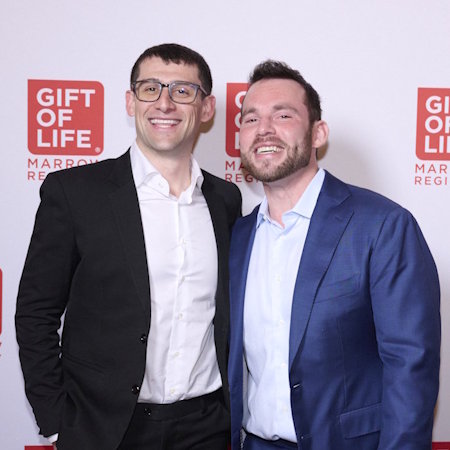
Thirty-six-year-old Jordan Stern (r), a resident of Washington D.C., who works at Adobe, was diagnosed with Common Variable Immune Deficiency (CVID) when he was 17 years old. This rare condition can cause tumors to appear and disappear and led to Jordan undergoing multiple surgeries including on his brain, lung, lymph nodes, appendix, and the need for repeated biopsies.
“I lived with the need for frequent infusions of medication and injections, plus taking 10-15 pills daily,” he said. Ultimately, he was told a stem cell transplant was his best treatment option.
His matching donor, Noah Letwat, 25, a chemical engineer from New York City, joined Gift of Life in 2019 during a recruitment drive at the Northeastern University chapter of his fraternity, Alpha Epsilon Pi. Noah’s cousin had been diagnosed with leukemia at only three years old, so he knew the importance of joining the registry as a volunteer donor.
“I am very excited to meet Jordan,” said Noah. “I’m happy I was able to do something good for him; I try to stay humble and just feel privileged I was given this opportunity.”
Gift of Life Board of Directors member Mindy Schneider first shared Jordan’s story then invited Noah to the stage, where they embraced to a standing ovation and cheers from event attendees.
“I’m 36 years old and have been sick for more than half my life,” said Jordan. “I have yearned for the day I could say, ‘I am healthy and can do as I please and don’t need to panic’, and it is all thanks to Noah and Gift of Life.”
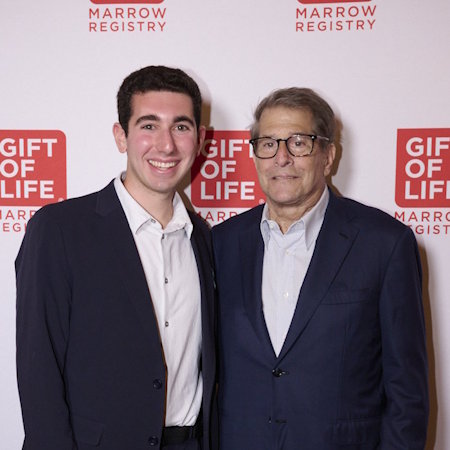
Feinberg introduced a second pair, welcoming leukemia survivor and transplant recipient Howard Kessler (r) to the stage and sharing his story. Kessler, 78, a resident of Boston, Mass., was diagnosed with acute myelogenous leukemia after an earlier diagnosis of myelodysplastic syndrome, and thankfully his team at Dana Farber Cancer Institute took immediate action and found his donor, Eli Weissman, 21, a resident of Lawrence, N.Y., in Gift of Life’s registry.
“I never thought I’d actually have the opportunity to save a life,” said Weissman. “I’m so privileged I got to do this, and in fact, I was asked to donate a second time. I got five-star treatment the whole way through. Also, my family is very proud that I was able to donate twice. I think about first responders and members of the military who put their lives on the line to save other people. I feel privileged that I got to save a life without any risk to my own line – it’s an opportunity that so few people get.”
Second donations, usually for white blood cells, are sometimes requested to help give patients a boost during their recovery.
As the two men met, Kessler thanked his donor for saving his life and told him that he had recovered so well that only eight months after the transplant, he was happy to be back on the tennis courts.
The night at The Breakers was really about seeing a big idea in action. What began as a simple belief in connecting heritage with giving back has turned into real, life-changing moments for people receiving stem cell transplants. Through their work together, Birthright Israel and Gift of Life have helped create hope that stretches across generations. As Bronfman and Feinberg talked about innovation, legacy, and the impact one person can have, the takeaway was clear: real change happens when compassion turns into action.